A new neuroscience perspective on trauma suggests the brain may be predicting danger — not storing pain in the body forever.
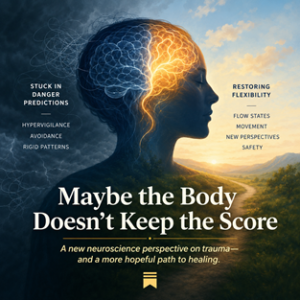
What if trauma isn’t trapped in your muscles, fascia or cells — but instead reflects a nervous system stuck expecting danger? Emerging neuroscience offers a more hopeful model of healing based on flexibility, movement, flow and retraining the brain’s predictions.
For years, one phrase has shaped how millions of people think about trauma: “The body keeps the score.”
Popularised by Bessel van der Kolk, the idea resonated deeply. Many people recognised themselves in it. Trauma did not just feel mental — it felt physical. Tight chest. Knotted stomach. Hypervigilance. Exhaustion. Panic. Chronic tension. Emotional shutdown.
The theory seemed to explain why painful experiences can linger long after the event itself has passed, but emerging neuroscience is beginning to challenge the literal interpretation of that phrase.
A new paper titled The body does not keep the score: trauma, predictive coding, and the restoration of metastability argues something surprisingly hopeful: Trauma may not be physically “stored” in the body at all, instead, the brain may be repeatedly recreating trauma responses through learned predictions of danger.
That distinction changes everything.
Trauma as prediction — not storage
The article proposes that the nervous system works less like a storage vault and more like a prediction machine. Your brain is constantly asking:
- Am I safe?
- What happens next?
- What should I expect?
- What do these bodily sensations mean?
After trauma, the brain can become overly convinced that danger is still present. This means:
- harmless sensations feel threatening
- bodily arousal becomes interpreted as danger
- the nervous system becomes hyper-alert
- the brain repeatedly confirms its own fearful predictions
For example: Your heart races slightly.
The brain predicts: “Something is wrong.”
You become anxious.
Your body reacts further. The brain then says: “See? I was right to be worried.”
And the cycle continues. According to the paper, this is not the body independently “holding” trauma in tissues or muscles, it is the brain continuously predicting danger and interpreting bodily sensations through that lens.
The nervous system gets stuck
The article introduces a fascinating concept called metastability. In simple terms, a healthy brain is flexible.
It can:
- adapt
- shift perspective
- calm down
- reassess situations
- move between emotional states
- tolerate uncertainty
Trauma appears to reduce this flexibility. The brain becomes stuck in rigid patterns:
- hypervigilance
- avoidance
- fear
- emotional shutdown
- repetitive thoughts
- defensive reactions
The authors compare it to becoming trapped in a deep mental ravine where the nervous system keeps falling back into the same pathways. The problem is not weakness, but reduced flexibility.
Why trauma feels physical
This model does not dismiss bodily symptoms. Trauma absolutely affects the body. People may experience:
- chronic tension
- fatigue
- digestive issues
- panic sensations
- shaking
- insomnia
- muscle pain
- emotional numbness
The article argues these symptoms are generated through brain–body feedback loops rather than frozen emotional energy stored in tissue. The body is participating in the process — but it is not necessarily an archive of trauma. That may sound subtle, but it is actually incredibly important. Because if trauma is prediction-based rather than permanently stored, then the nervous system can learn new predictions. This in turn means healing is possible.
The surprising importance of flow states
One of the most interesting parts of the paper explores flow states. Flow is that feeling of total absorption where:
- time disappears
- self-consciousness fades
- attention becomes fully focused
- action feels natural and fluid
Examples include:
- surfing
- singing
- dancing
- hiking
- gardening
- painting
- music
- writing
- swimming
- sport
- creative work
The authors suggest flow states may help restore flexibility in brain networks damaged by trauma. In other words: trauma narrows the nervous system…
while flow expands it again. Flow may:
- quiet overthinking
- reduce hypervigilance
- improve adaptability
- increase confidence
- retrain the brain to experience arousal safely
Importantly, healing may not always come through endlessly revisiting pain. Sometimes healing may come through re-engaging with life.
Why many therapies can help
This framework also helps explain why so many completely different therapies sometimes work. The article suggests successful approaches may all improve flexibility in the nervous system. These include:
- EMDR
- mindfulness
- psychotherapy
- exercise
- nature exposure
- creativity
- psychedelics / functional mushrooms (research, use with care/caution)
- breathwork
- exposure therapy
- movement-based therapies
The common denominator may not be “releasing stored trauma.” It may be restoring adaptability and reducing rigid threat prediction.
Key takeaway: you are not permanently broken
This is perhaps the most hopeful part of the paper. The authors point out that most people exposed to trauma do not develop lifelong PTSD and that many recover naturally over time. Why? Because the nervous system retains the ability to recalibrate.
The brain remains plastic, adaptable, changeable.
The paper argues healing is less about:
- excavating buried pain
- purging trauma
- locating emotional residue in tissues
and more about:
- retraining the nervous system
- rebuilding flexibility
- restoring agency
- increasing safety signals
- expanding life again
Practical ways to support nervous-system flexibility
The article points toward several practical approaches that may help restore regulation:
Move the body gently
Walking, stretching, swimming, yoga and exercise may help retrain safety and movement.
Seek healthy flow states
Find activities where you become deeply absorbed and engaged.
Reduce chronic avoidance
Trauma often shrinks life. Gentle re-engagement matters.
Improve cognitive control
Sleep, mindfulness, meditation and structured routines can help strengthen regulation.
Reinterpret bodily sensations
A racing heart is not always danger. Sometimes it is simply activation.
Build safe social connection
The nervous system regulates through relationships as much as through thoughts.
A more hopeful story
The paper is not claiming trauma is imaginary, nor dismissing people’s suffering. Instead, it offers a newer and arguably more empowering framework. The body may not literally “keep the score,” but the brain keeps predicting it, so if predictions can change… then recovery remains possible. Healing may not require digging endlessly into the past.
Sometimes it begins with restoring movement: movement in thought, behaviour, emotion and in life itself.
If on reading this you are seeking healing, research an enlightened independent therapist who helps you to focus on how you would like to feel going forwards rather than staying in a loop of recurring feelings of stuck trauma. Take on board the idea that you are “not broken”, and step forwards, one step at a time. You’ve got this.
References
- Allen, M. et al. (2022) — Active inference and the embodied mind
- Alameda, L. et al. (2022) — Neurobiology of flow states and transient hypofrontality
- Bonanno, G. A. (2004) — Loss, trauma and human resilience
- Bonanno, G. A. et al. (2015) — Resilience trajectories after trauma exposure
- Bomyea, J. & Amir, N. (2011) — Working memory capacity and intrusive thoughts
- Damasio, A. R. (1989) — Time-locked multiregional retroactivation
- Damasio, A. R. (1994) — Descartes’ Error
- Engdahl, B. et al. (2010) — MEG connectivity findings in PTSD
- Friston, K. (2010) — The free-energy principle and predictive coding
- Geraerts, E. et al. (2007) — False memories and trauma recall
- Hancock, R. et al. (2025) — Emerging metastability research in trauma models
- Hellyer, P. J. et al. (2015) — Metastability and cognitive flexibility following connectome disruption
- Kotler, S. (2014) — The Rise of Superman
- Kotler, S. et al. (2022) — Flow neuroscience and optimal performance
- Meyer, K. & Damasio, A. (2009) — Convergence-divergence zones and memory
- Shin, L. M. et al. (2006) — Amygdala and medial prefrontal dysfunction in PTSD
- Spoelstra, J. et al. (2000) — Predictive movement and sensory attenuation
- van der Kolk, B. (2014) — The Body Keeps the Score
- Walter, K. H. et al. (2023) — Surf therapy, hike therapy and depression outcomes in military personnel
Further Reading
Trauma & the Nervous System
- The Body Keeps the Score — Bessel van der Kolk
- Waking the Tiger — Peter Levine
- In an Unspoken Voice
Predictive Processing & Neuroscience
- Surfing Uncertainty — Andy Clark
- The Predictive Mind — Jakob Hohwy
- Descartes’ Error — Antonio Damasio
Flow States & Performance
- Flow — Mihaly Csikszentmihalyi
- The Rise of Superman — Steven Kotler
Resilience Research
- Work by George Bonanno on trauma recovery and resilience trajectories
This article was curated and interpreted by the author using published neuroscience and trauma research, with editorial assistance from AI to help translate complex concepts into accessible language.
Buy me a coffee: https://buymeacoffee.com/yi4kcpgjtu