Understanding What Drives Us
Human motivation is often more layered than it seems. In 1943, psychologist Abraham Maslow proposed that our needs follow a natural hierarchy — a pyramid that moves from basic survival to self-fulfilment. His model remains one of the most widely recognised frameworks in psychology and wellbeing today.
At its foundation, Maslow’s hierarchy shows that before we can reach our higher potential, our more fundamental needs must first be met.
-
Physiological Needs – The essentials for life: food, water, warmth, rest, and shelter. Without these, higher goals lose their meaning.
-
Safety Needs – Once basic survival is secured, we seek safety: physical protection, stability, order, and freedom from fear.
-
Love and Belonging – Humans thrive on connection. Relationships, intimacy, friendship, and community give emotional nourishment.
-
Esteem Needs – These relate to self-respect and recognition. Confidence grows when we feel valued and competent.
-
Self-Actualisation – The top of the pyramid represents fulfilment: creativity, purpose, morality, and realising one’s potential.
Maslow suggested that people move up and down this hierarchy throughout life depending on circumstances — illness, stress, or change can push us back to focus on more basic levels. In modern wellbeing work, the hierarchy offers a simple reminder: we can’t pour from an empty cup.
Below is the classic diagram showing the five levels of Maslow’s pyramid:
Maslow’s Hierarchy of Needs Diagram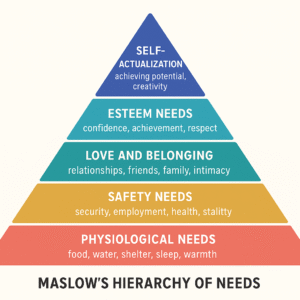
Reference:
Maslow, A. H. (1943). A Theory of Human Motivation. Psychological Review, 50(4), 370–396.
Click here for a worksheet to support this article